
I've been gluten-free since December, 2025. My bloodwork was heading toward Hashimoto's, my doctor said going gluten-free would help lower the antibodies, and I listened. That part was straightforward.
The part nobody warns you about is the bread. Real bread. The kind with a crackly crust and a soft middle that actually tastes like something. Gluten-free bread from a bag is fine, but it's not bread bread. So on October 30, I started a gluten-free sourdough starter.
Her name is Wheatless Everdough, the bread on fire.
The recipe
This one uses buckwheat flour and white rice flour — no wheat anywhere in the building. Certified gluten-free flours, clean utensils, and a loose cover on the jar. Never airtight.
Day 1: 30g buckwheat flour + 35g water. Stir it up, cover it loosely, and leave it alone.
Day 2: Keep 30g. Feed it 20g buckwheat + 10g white rice + 35g water.
Day 3 and on: Keep 30g. Feed it 15g buckwheat + 15g white rice + 35g water, every 24 hours.
Keep her somewhere warm — 72 to 78 degrees is the sweet spot.
That's the whole recipe. Simple on paper. In practice, she has opinions.
The honest middle
Day 3, I dumped in 25 grams too much water by accident and had to balance it out with extra flour. Day 5, I argued with the math — the discard was 57 grams, not 65, and my kitchen scale won that argument. Day 6, I forgot to feed her entirely.
She's fine. Starters are a lot more forgiving than the internet makes them sound. One missed day doesn't kill her. She just gets hungry, and a little dramatic about it.
I keep her in a giant jar, which means the 30 grams I'm supposed to keep looks like a smear on the bottom. So I do it backwards from the recipe: I spoon the starter out until the jar is down to that little puddle, weigh what came out, and that's the discard. The number changes every day. The puddle doesn't lie.
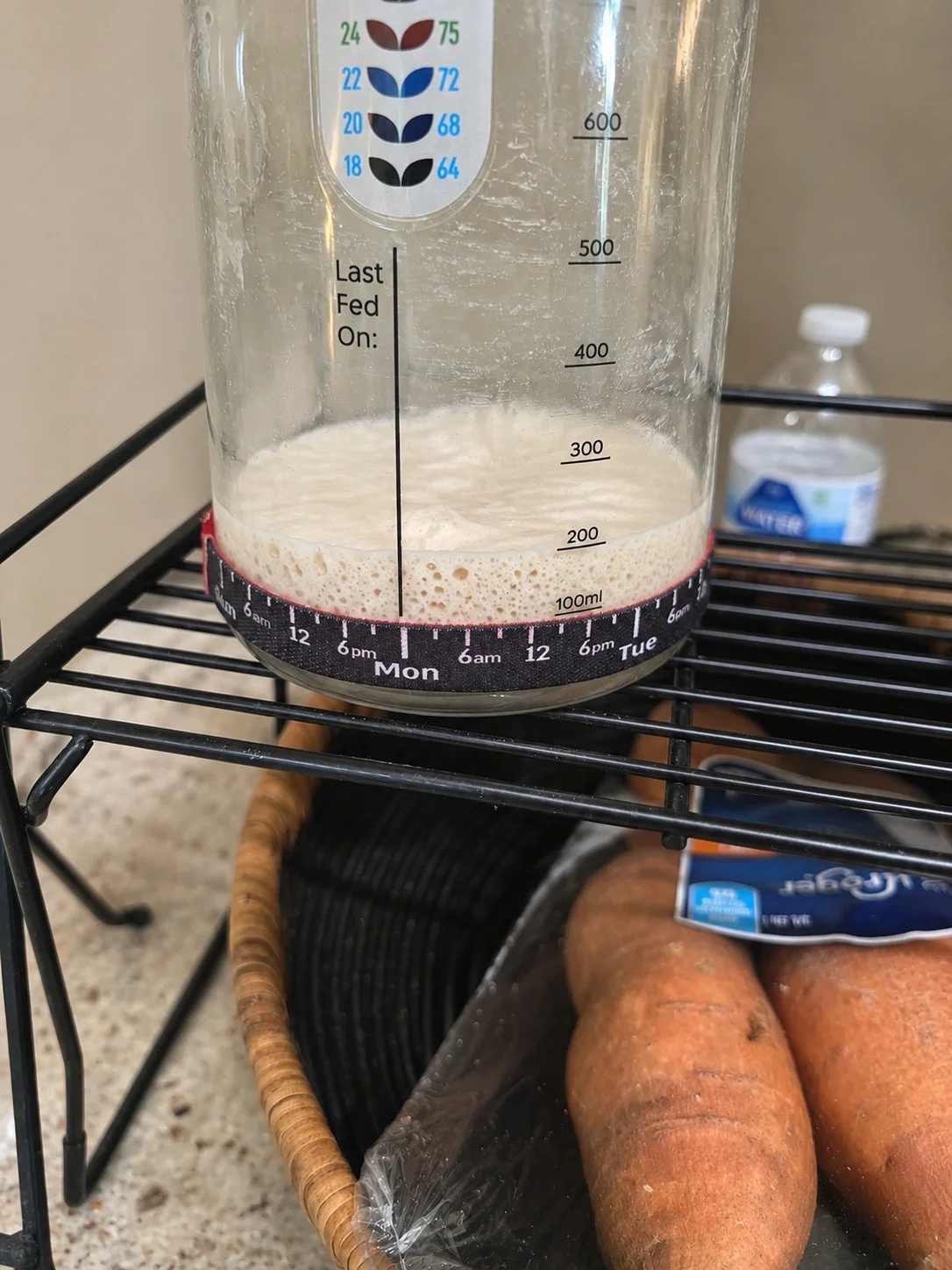
Wheatless Everdough on Day 7, about seven hours after her morning feeding — bubbly, domed, risen to about 250 mL, and sitting right around 75°F.
How I'll know she's ready
The recipe says 7 to 14 days, maybe longer. And here's the thing nobody tells you about gluten-free starters: they might never double. If you're standing over the jar waiting for it to double like a regular starter, you'll be waiting forever and thinking you failed.
She's ready when I see all of these together: consistent bubbles, a sour or fruity smell, a domed surface, and a rise that repeats itself after every feeding. Not one good day — a pattern.
Once she's established, she moves to the fridge, gets fed about once a week, and I keep her at 100 mL minimum. Before I bake with her, she gets a few room-temperature feedings to wake back up. The first bake is coming. I'm not rushing her.
Why the name
My last starter — back before I went gluten-free — was named Andoughna, after Andarna the dragon in Fourth Wing. So this one had a standard to live up to.
Wheatless Everdough. Katniss Everdeen. The girl on fire, except she's bread. Naming your starter is not optional in this house.
If you're thinking about starting one
Use certified gluten-free flours. Keep your utensils clean. Don't panic over a missed day, a wrong number, or a jar that doesn't look like the pictures. Watch for bubbles and smell and a surface that domes up after feeding — that's your starter talking to you.
And give her a name. It helps.
This is my story, not medical advice — talk to your doctor.
